Artificial intelligence (AI) is entering a new era. AI is no longer limited to generating text, images, and code or answering questions. It is increasingly being designed to **interact directly with physical devices in the real world**.
On August 27, 2026, [Anthropic](https://www.anthropic.com/) introduced a research preview of the **Model Hardware Standard (MHS)**, a specification designed to enable AI agents to communicate with and operate a wide range of physical devices that have programmable interfaces.
The technology could move AI beyond the role of a traditional *digital assistant* toward systems capable of **planning, executing, monitoring, and adapting tasks in the physical world**.
## From AI on Screens to AI That Can Control Machines
One of the long-standing limitations of AI has been its ability to directly interact with physical equipment.
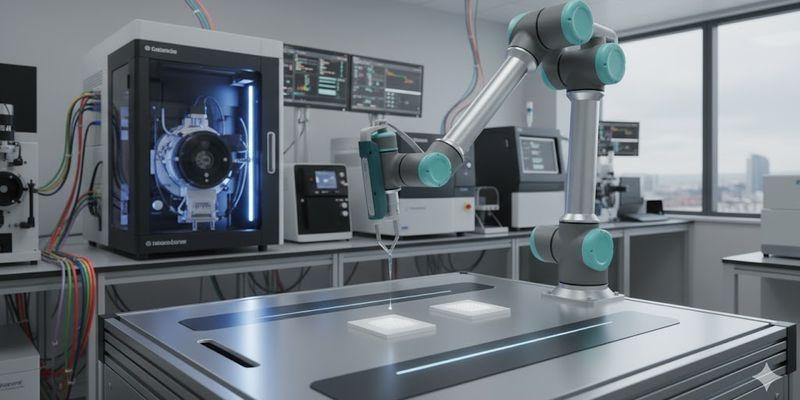
A laboratory, for example, may contain microscopes, robotic arms, liquid handlers, sensors, and analytical instruments. Each device can have its own control system and interface, often requiring custom integration before an AI system can interact with it.
Anthropic developed MHS to address this challenge.
With MHS, programmable devices can be made easier for AI agents to discover and operate through a more standardized communication approach.
In simple terms, MHS can be viewed as a **communication layer between AI and physical hardware**.
An AI agent can identify which devices are available, understand their capabilities, check their current status, and then execute the appropriate instructions.
## One AI Agent Can Coordinate Multiple Devices
One of the most interesting aspects of MHS is its ability to allow an AI agent to coordinate multiple devices as part of a single workflow.
Anthropic has demonstrated the concept in a laboratory environment involving a **liquid handler, robotic arm, and microplate reader**. These devices can be coordinated as part of a workflow managed by an AI agent.
In such a scenario, the AI does more than simply send a command to a single machine.
It can execute processes sequentially, receive data from different devices, analyze the results, and potentially adjust parameters for subsequent steps.
This approach could pave the way for increasingly automated laboratories, where researchers define the objectives while AI systems assist with operational and experimental tasks.
## Potential to Accelerate Drug Discovery
One of the areas that could benefit significantly from this technology is **drug discovery**.
Biological and pharmaceutical research often requires multiple instruments to work together. Setting up and integrating individual machines can take weeks or even months, particularly when different systems use different software and communication protocols.
According to Anthropic, MHS is designed to simplify this hardware integration process. During early testing, the company reported that some partners were able to reduce hardware integration time from **weeks to hours**.
If this approach can be deployed more broadly, laboratories could potentially conduct more experiments within the same period.
AI agents could also help adjust experimental parameters based on data received directly from laboratory equipment, creating a more adaptive research workflow.
## AI Could Also Support Quantum Computing
The potential applications of MHS extend beyond biological laboratories.
Anthropic has highlighted the possibility of using the standard for tasks such as **laser calibration in quantum computing systems**.
This demonstrates a broader direction for AI development. AI is no longer being positioned solely as software that processes digital information. It could increasingly become an intelligence layer connecting AI models with scientific and industrial equipment.
## AI Still Cannot Fully Replace Humans
Despite the potential of autonomous laboratories, the technology remains in its early stages.
Anthropic acknowledges that current AI models still have limitations when dealing with complex physical conditions in the real world.
During one laboratory test, for example, an AI system encountered a problem involving **bubbles in a liquid sample**. The model initially interpreted the problem as a software-related issue and attempted to repeat the process.
The actual cause, however, was a physical phenomenon involving the liquid that required a different adjustment to the equipment.
The example highlights an important limitation: AI still requires **human oversight and expert knowledge**, particularly when dealing with physical conditions that cannot be fully understood through digital information alone.
## Moving Toward the Era of Physical AI
The development of MHS is part of a broader trend known as **Physical AI**.
While earlier generations of generative AI primarily focused on understanding and generating information, Physical AI seeks to extend intelligence into the physical environment.
In the future, AI systems could potentially interact with:
* Industrial robots
* Robotic arms
* Microscopes
* Laboratory equipment
* Manufacturing machines
* Cameras and sensors
* Electronic devices
* Autonomous vehicle systems
* Scientific instruments
In a long-term scenario, a researcher could potentially provide instructions in natural language describing the experiment they want to conduct.
An AI agent could then plan the required steps, identify available equipment, execute the experiment, analyze the results, and make adjustments based on the outcome.
However, achieving this level of automation will require significant further development, along with robust safety mechanisms and human oversight.
## MHS Is Not a Robot or a New AI Model
It is important to understand that the **Model Hardware Standard is neither a robot nor a new AI model**.
Instead, MHS is a specification designed to provide a standardized communication layer that helps AI agents interact with physical hardware.
The concept is similar to a **standardized interface**. Different devices can expose their capabilities through a more consistent method, reducing the need to create a completely custom integration for every machine.
Anthropic also describes MHS as **model-agnostic**, meaning the standard is not designed exclusively for a single AI model.
The company has indicated that the standard is intended to be developed with the broader community and potentially made available through an open-source approach following further testing and evaluation.
## What Could This Mean for the Future?
If technologies such as MHS continue to develop successfully, the relationship between AI and machines could change significantly.
Today, humans remain the primary bridge between:
**Instructions → Software → Machine → Results**
In the future, some of those steps could increasingly be handled by AI agents.
Humans could provide high-level objectives, while AI systems handle portions of the operational work, analysis, and coordination between different devices.
This shift could have a significant impact on industries including **manufacturing, pharmaceuticals, robotics, scientific research, electronics, semiconductors, and quantum technology**.
At the same time, greater AI control over physical devices makes **security, access control, instruction validation, system reliability, and human oversight** increasingly important.
With MHS, Anthropic is effectively working on one of the potential bridges between **digital intelligence and the physical world**.
And if standards like this become widely adopted, the next chapter of AI may no longer be defined solely by how intelligently AI can answer questions.
It may increasingly be defined by **how intelligently AI can take action**.